

Quick Verdict: “Cheap” n8n hosting is only cheap on the invoice. Once you add setup time, maintenance hours, and the cost of things breaking at 2am, a $4/month VPS often ends up more expensive than a $6–$8/month managed instance — and nowhere near as reliable. Below is the actual math, not the marketing math.
Table of Contents
The “Cheap n8n Hosting” Myth
Type “cheap n8n hosting” into Google and you’ll land on a dozen guides telling you to grab a $4 VPS from Hetzner or Contabo, run a Docker Compose file, and you’re “saving hundreds a year” over n8n Cloud.
Technically, that’s true. The server itself genuinely costs $4–$7 a month.
What those guides don’t tell you is what happens in week three, when your SSL certificate silently expires and every webhook starts failing. Or month two, when a Postgres update breaks your container and you spend a Saturday in Docker logs instead of building automations. Or the night your lead-capture workflow goes down for six hours because nobody was watching the server — and six hours of missed leads costs you more than a year of hosting.
We’re not here to talk you out of self-hosting. Some of you should absolutely run your own VPS. But “cheap” and “low total cost” are two very different things, and almost nobody compares them honestly. So we did the math — real 2026 pricing, real provider numbers, real scenarios — and laid out exactly what each path costs once you stop pretending maintenance time is free.
Three Ways to Run n8n in 2026
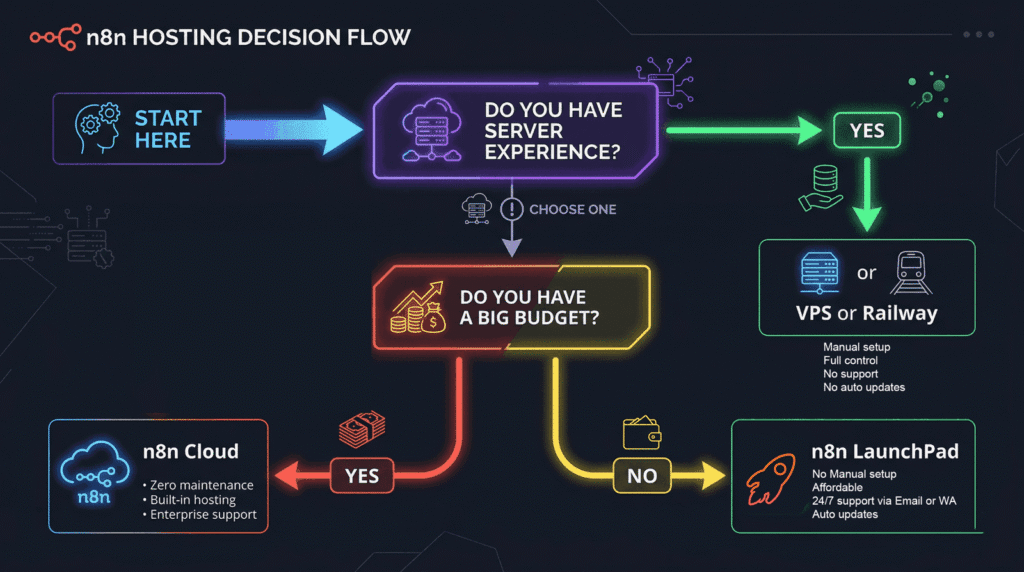
There are really only three roads into n8n, and most comparison articles only cover two of them.
1. n8n Cloud — n8n’s own official hosted product. Zero setup, but billed by execution count, and the pricing ceiling is steep (more on that below).
2. Self-Hosted on a Raw VPS — You rent a server from Hetzner, DigitalOcean, Contabo, or similar, install Docker yourself, and run the free n8n Community Edition. The software costs nothing. The server does. So does your time.
3. Managed n8n Hosting — A pre-configured, fully maintained n8n instance on dedicated infrastructure, set up and looked after by someone else. You get the “no execution limits” benefit of self-hosting without touching a terminal. This is the category most people don’t know exists until they’ve already been burned by option 1 or option 2.
This article is mainly about options 2 and 3 — because that’s where the real “cheap vs managed” decision actually lives.
What “Cheap” VPS Hosting Actually Costs
Let’s start with sticker price, because it really is low. Here’s where things stand in 2026 for the kind of small instance that comfortably runs n8n:
| Provider | Typical Entry Plan | Specs | Approx. Monthly Cost |
|---|---|---|---|
| Hetzner Cloud (CX22) | Shared vCPU | 2 vCPU, 4GB RAM | ~€3.79–4.51 (~$4.50) |
| DigitalOcean | Basic Droplet | 1 vCPU, 1GB RAM | ~$4–6 |
| Contabo (VPS 10) | 12-month contract | 4 vCPU, 8GB RAM | ~€3.60 (~$4.95) |
| RackNerd | Promo annual plan | 1 vCPU, 1GB RAM | Under $1–5 (promo pricing) |
On paper, that’s an n8n instance for less than a cup of coffee a month. It’s genuinely the cheapest dollar-for-dollar option on this entire list, and we’re not going to pretend otherwise.
But that table only covers the server. It says nothing about what it takes to turn an empty Linux box into a production-ready n8n instance — and that’s where the real comparison starts.
The Hidden Costs Nobody Puts in the Comparison Table
This is the part every “cheap n8n hosting” listicle skips, because it doesn’t fit neatly into a price column. Here’s everything you’re actually signing up for when you go the raw-VPS route.
Initial setup (one-time, but real)
You’re installing Docker, deciding between SQLite and Postgres for your database, configuring a reverse proxy (usually Nginx or Caddy), generating and renewing SSL certificates, setting environment variables correctly, and opening the right firewall ports. If you’ve done this before, it’s a focused afternoon. If you haven’t, it’s a weekend with a lot of Stack Overflow tabs open.
Ongoing maintenance (every single month)
- Security patches. Linux and Docker both need regular updates. Skip them long enough and you’re an easy target.
- SSL renewal. Let’s Encrypt certificates expire every 90 days. Most people set up auto-renewal and forget about it — until it silently fails and every webhook breaks.
- Backups. n8n stores your workflows, credentials, and execution history in a database. If that database isn’t backed up off-server, one bad
docker compose down -vwipes everything. - n8n version upgrades. New releases ship constantly. Upgrading without breaking your active workflows takes care.
- Monitoring. A raw VPS doesn’t tell you when it’s down. You either set up monitoring yourself or you find out from an angry customer.
Downtime risk
This is the one founders underestimate the most. If your VPS goes down at 3am and nobody’s watching, your WhatsApp lead-notification workflow, your WooCommerce order sync, or your AI support agent is just… off. Not slow. Off. For however long it takes you to notice.
None of this means self-hosting is bad. It means the $4.50/month sticker price is the tip of the iceberg, not the total cost.
n8n Cloud’s Real Cost (The Quick Version)
We’ve gone deep on this in our n8n Cloud Review, so here’s the short version relevant to this comparison:
| Plan | Price | Executions/Month | Concurrent Workflows |
|---|---|---|---|
| Starter | ~$24/mo | 2,500 | 5 |
| Pro | ~$60/mo | 10,000 | 20 |
| Business | ~$800/mo | 40,000 | Unlimited |
| Enterprise | Custom | Custom | Custom |
The trap isn’t the price — it’s the cliff. There’s no graceful overage. Hit your execution cap and every workflow stops dead until the next billing cycle. For a founder running even a handful of webhook-triggered or polling workflows, 2,500 executions disappears faster than expected, and the jump from Pro to Business is brutal: $60/month to $800/month, with nothing in between.
That gap is exactly the space managed hosting was built to fill.

Managed n8n Hosting — What You’re Actually Paying For
Managed hosting takes the free, self-hosted Community Edition of n8n — the same unlimited-execution software you’d run on a raw VPS — and puts someone else in charge of the server, the Docker setup, the SSL, the backups, and the uptime. You’re not paying for the software. You’re paying for the headache to disappear.
Here’s how the main options compare as of mid-2026:
| Provider | Starting Price | Setup Required | Execution Limits | Who Manages It |
|---|---|---|---|---|
| n8n LaunchPad | $6–$8/mo | None — pre-deployed | None | Fully managed |
| InstaPods | $3–$7/mo | None — one-click deploy | None | Fully managed |
| Sliplane | ~€9/mo (~$10) | Minimal — you run the container | None | Server managed, app is yours |
| ScalaHosting | ~$29.95/mo | None | None | Fully managed, premium support |
| n8n Cloud (official) | $24–$800/mo | None | Yes — strict caps | Fully managed |
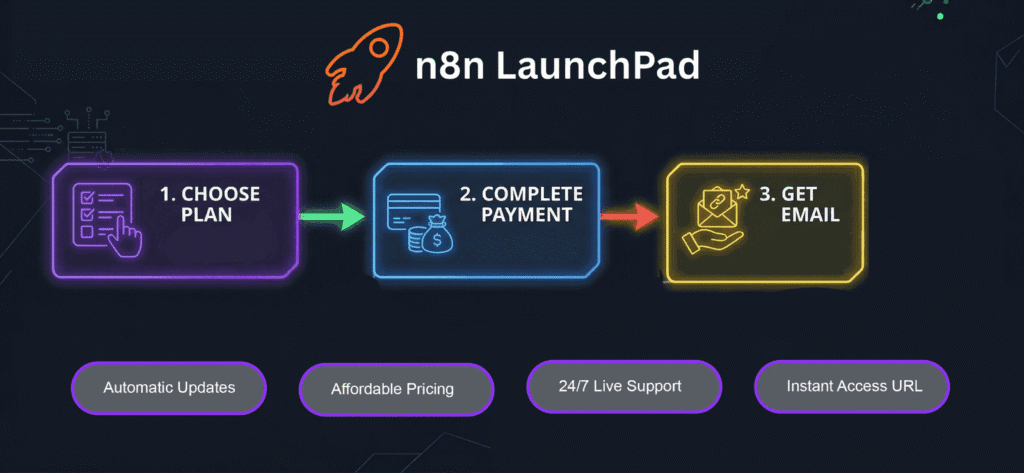
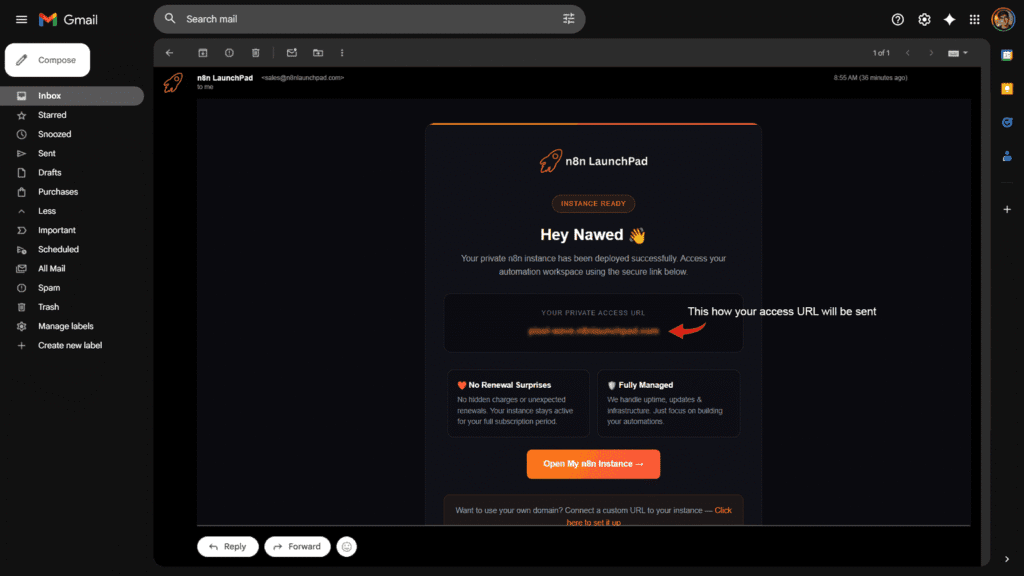
A few things worth pointing out honestly: InstaPods is genuinely competitive on raw price. Sliplane gives you more infrastructure control if you want to run other containers alongside n8n. ScalaHosting is priced more like an enterprise support package than a budget option. n8n LaunchPad sits in the sweet spot — pre-deployed and zero-touch like InstaPods, but built specifically around being a drop-in n8n Cloud replacement: same “just start building” experience, none of the execution ceiling, at a fraction of the price.
The Real 12-Month Cost Analysis
This is the part most articles skip entirely. Let’s build one real scenario and run the numbers for all three paths over a full year.
The scenario: A solo founder running five fairly modest automations — nothing exotic, just normal small-business workflow stuff:
| Workflow | Frequency | Monthly Executions |
|---|---|---|
| WhatsApp lead notification (webhook) | ~80/day | 2,400 |
| Brevo email sequence trigger | ~40/day | 1,200 |
| WooCommerce order sync + customer email | ~60/day | 1,800 |
| Scheduled social posting (every 20 min) | 72/day | 2,160 |
| AI customer support agent | ~100/day | 3,000 |
| Total | 10,560 |
Five completely ordinary workflows, and you’re already past n8n Cloud’s Pro plan ceiling of 10,000. That’s not an edge case — that’s a normal early-growth business.
Path 1 — n8n Cloud. At 10,560 executions, Pro ($60/mo) isn’t enough. Once you hit the 10,000 cap, everything stops — including your lead notifications and order sync — until the cycle resets. Your realistic options are to either trim workflow frequency (and lose automation reliability) or jump to Business at $800/month for headroom you don’t need. Annual cost: $720 (Pro, with regular outages) or $9,600 (Business, to stay safe).
Path 2 — Raw VPS, self-hosted. A Hetzner CX22 runs about $5/month: $60/year in server costs. Unlimited executions, no cap. But you’re also looking at an initial setup of several hours, plus realistically 2–4 hours a month in ongoing maintenance — patching, backup checks, the occasional broken upgrade. That’s roughly 24–48 hours a year of your time. Even valuing your time conservatively at $10/hour, that’s $240–480/year in time cost on top of the $60 server bill — before counting any downtime risk.
Path 3 — Managed hosting (n8n LaunchPad). Flat $8/month, unlimited executions, zero maintenance. Annual cost: $96. No setup weekend, no SSL renewals, no 3am downtime to debug yourself.
| n8n Cloud | Raw VPS (DIY) | Managed (LaunchPad) | |
|---|---|---|---|
| Sticker price/year | $720–$9,600 | $60 | $96 |
| Execution limit | Yes — hard cap | None | None |
| Setup time | None | 4–8 hrs | None |
| Maintenance time/year | None | 24–48 hrs | None |
| Downtime risk | Low (managed) | You own it | Low (managed) |
| Realistic all-in cost | $720–$9,600 | ~$300–540 | $96 |
The honest takeaway: a raw VPS is still the cheapest option in pure dollars. We’re not going to pretend otherwise — if your time costs you nothing and you enjoy server work, $60/year is hard to beat. But once you price in even a conservative value for your own hours, the gap between “cheapest” and “managed” shrinks to about $3–4 a month — and on the other side of that gap is zero maintenance, zero downtime risk, and zero weekends lost to a broken Docker upgrade.
When Cheap VPS Self-Hosting Actually Makes Sense
We’re not anti-DIY. Self-hosting on a raw VPS is the right call if:
- You already manage servers for other projects, so the marginal effort is near zero
- You genuinely enjoy infrastructure work and it’s not “time you’d rather spend building”
- You’re running other apps on the same box anyway, so n8n is just one more container
- You have hard compliance or data-residency requirements that need full infrastructure control
- Your execution volume is genuinely tiny and unlikely to ever need active maintenance attention
If that’s you, Hetzner is the best raw price-to-performance pick on the market right now, and there’s nothing wrong with running n8n there.
When Managed Hosting Wins
For most solo founders and small teams — especially non-technical ones — managed hosting is the better call:
- You’d rather spend your hours on marketing, sales, or product than on Docker logs
- You don’t have a backup plan if your server goes down at 2am
- You’re scaling fast and don’t want execution limits surprising you mid-launch
- You’ve already been burned once by an n8n Cloud overage or a broken self-hosted upgrade
- You just want to open the n8n editor and start building — today, not this weekend
Why Founders Are Moving to n8n LaunchPad?
n8n LaunchPad exists specifically for the gap this whole article has been mapping out: the space between “cheap but you’re the sysadmin” and “managed but priced like enterprise software.”
Here’s what that actually looks like:
- $6/mo and $8/mo plans — a fraction of n8n Cloud’s $24–$800 range
- No execution caps, no workflow limits — the same freedom you’d get self-hosting, without owning the server
- Pre-deployed in minutes — no Docker, no SSL setup, no reverse proxy configuration
- Updates, backups, and uptime handled for you — the maintenance burden this entire article has been breaking down simply isn’t yours to carry
If the math above resonated — if you read the “raw VPS” section and felt your stomach drop thinking about SSL renewals or 3am downtime — that’s the exact signal that managed hosting is the right fit for where you are right now.
You can spin up a fully managed n8n instance and be building your first workflow in the time it would’ve taken to just finish reading a Docker installation guide.
Final Verdict
| Category | Score |
|---|---|
| Raw VPS — cheapest in dollars | ⭐⭐⭐⭐⭐ (5/5) |
| Raw VPS — lowest effort | ⭐ (1/5) |
| n8n Cloud — ease of setup | ⭐⭐⭐⭐⭐ (5/5) |
| n8n Cloud — cost at scale | ⭐⭐ (2/5) |
| Managed hosting — cost-to-effort ratio | ⭐⭐⭐⭐⭐ (5/5) |
| Managed hosting — scalability | ⭐⭐⭐⭐⭐ (5/5) |
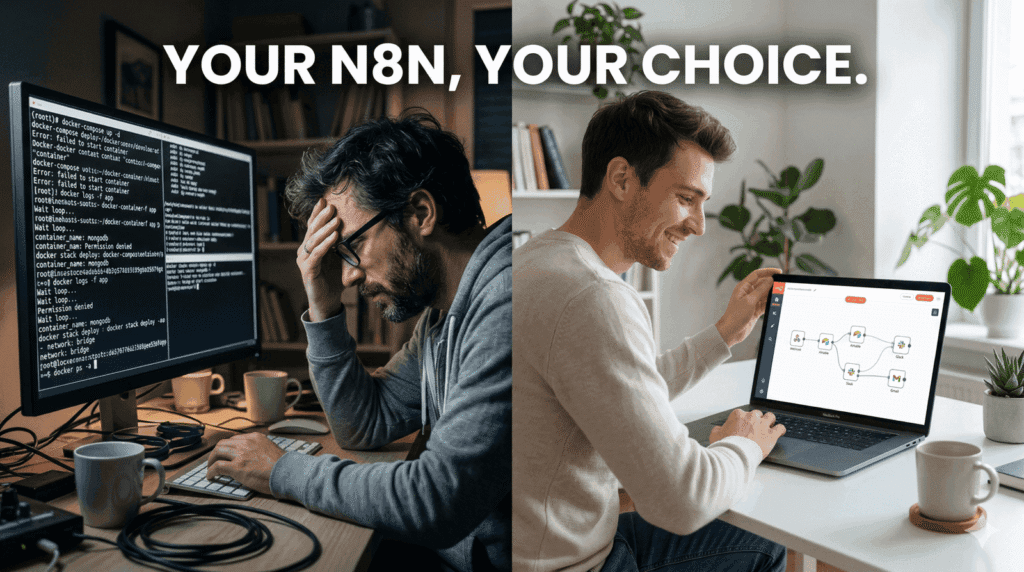
Bottom line: If you’re technical, enjoy server work, and your time genuinely costs nothing, a $4.50 VPS wins on price alone. For everyone else — which is most solo founders, agencies, and small teams — managed hosting delivers 95% of self-hosting’s cost advantage over n8n Cloud, with none of the maintenance risk. That’s the entire reason n8n LaunchPad exists.
Frequently Asked Questions
Is self-hosting n8n actually free?
The n8n Community Edition software is completely free with unlimited executions. But “free software” still needs a server to run on, which costs $4–$20/month depending on the provider, plus your time for setup and ongoing maintenance. The software is free; running it reliably isn’t.
What’s the cheapest way to host n8n?
A raw VPS from Hetzner, DigitalOcean, or Contabo is the cheapest option in pure dollar terms, typically $4–$7/month. It requires you to handle Docker, SSL, backups, and updates yourself, so the true cost includes your time, not just the invoice.
How much does managed n8n hosting cost?
Managed n8n hosting in 2026 generally runs $6–$10/month depending on the provider, compared to n8n Cloud’s $24–$800/month range. n8n LaunchPad starts at $6/month with unlimited executions and zero setup required.
Is n8n LaunchPad cheaper than n8n Cloud?
Yes. n8n LaunchPad starts at $6–$8/month with no execution limits, compared to n8n Cloud’s $24/month Starter plan (2,500 executions) up to $800/month for Business. For any workload beyond light, occasional use, LaunchPad works out significantly cheaper.
Can I switch from a VPS to managed hosting later?
Yes. n8n lets you export workflows as JSON files, so moving from a self-hosted VPS to a managed instance is straightforward. Credentials don’t transfer automatically, so you’ll need to reconnect your integrations after the move, but your workflow logic carries over.
Does cheap VPS hosting have execution limits like n8n Cloud?
No. Self-hosted n8n (whether on a raw VPS or through managed hosting) runs the free Community Edition, which has no execution limits or workflow caps. The limits you see on n8n Cloud are specific to n8n’s official hosted product, not the open-source software itself.
What hidden costs come with self-hosting n8n on a VPS?
Beyond the server bill, expect time costs for initial Docker and SSL setup, ongoing security patching, SSL certificate renewal every 90 days, database backups, n8n version upgrades, and monitoring for downtime. None of these show up on the provider’s pricing page.
Is managed n8n hosting secure?
Reputable managed n8n hosting providers like n8n LaunchPad, handle security patching, SSL, and backups as part of the service — generally more consistently than a solo founder managing a VPS manually, simply because it’s someone’s full-time job to keep those systems current.
How long does it take to set up self-hosted n8n vs managed hosting?
A raw VPS setup typically takes a focused afternoon to a full weekend if you’re doing it for the first time — Docker, database, reverse proxy, SSL. A managed instance is pre-deployed, so you’re usually building your first workflow within minutes of signing up.
Which option is best for non-technical founders?
Managed hosting. It gives you the same unlimited-execution freedom as self-hosting without requiring any server administration knowledge, at a price point ($6–$10/month) that’s close enough to raw VPS hosting that the time and risk saved make it the clear default choice.
Last updated: June 2026. Pricing reflects publicly listed rates as of the publication date and may change — always verify current pricing directly with each provider before deciding.